From Chaos to Cadence.
Right Nurse.
Right Patient. Right Now.

Shift2Shift is the AI-driven Healthcare Nurse Assignment Platform for your Health System that transforms reactive nurse staffing into Proactive Human Capital Optimization, ensuring every assignment is clinically sound, equitable, and cost-effective.
A clinical innovation forged by nursing leaders, proven and refined within one of the world’s most recognized health systems.
Shift2Shift is an AI-driven SaaS platform that automates the charge nurse assignment process by functioning as an intelligence layer between the EHR and Workforce Management (WFM) systems. Forged by clinical leaders, the platform’s multi-layered rules engine ingests patient acuity, skills, and unit census to generate optimal, equitable assignments. This transformation moves the organization “From Chaos to Cadence,” ensuring 100% compliance with mandates while balancing workloads to reduce burnout and reliance on costly premium labor.
The Critical Role of Nurse Staffing Optimization
Ensuring Compliance and Continuity
In the dynamic world of healthcare, retention and continuity optimization are paramount. By adhering to strict non-negotiable rules, we ensure that staffing assignments are fair and compliant, preventing burnout and enhancing patient care. Our system goes beyond mere numbers, balancing workload and geographic distribution to maintain a satisfied and effective workforce.
The Dual Crisis

Financial Drain
Inefficient assignments create “perceived shortages,” forcing reliance on expensive agency and overtime staff. The cost to replace a single RN is estimated at $40,000 to $52,000.

Clinical Burnout
Unfair, non-transparent assignments and acuity overload are top drivers of nurse burnout. Charge Nurses spend 30–60 minutes per unit, per shift on manual assignment coordination.

Enterprise Risk & Compliance
Inadequate staffing is linked to adverse patient outcomes. The platform is a fully auditable system supporting The Joint Commission’s 2026 National Performance Goal 12 on staffing governance.
Core Technology
The Multi-Layered Assignment Engine
The Intelligence Behind Every Assignment is Optimal Matching.
Our platform moves beyond simple ratios to consider hundreds of data points, applying a sophisticated, multi-layered set of rules to find the optimal match.
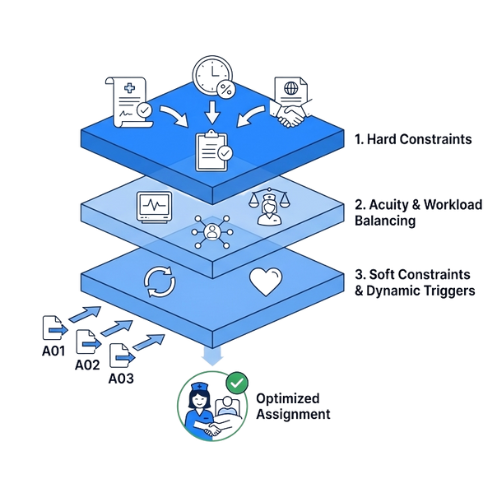
Hard Constraints
(The Non-Negotiables)
Foundation & Safety: The system first ensures 100% compliance with foundational rules. Violating any rule—such as licensure, certification (e.g., ACLS), mandated ratios, or union contracts—instantly invalidates an assignment.
Acuity & Workload Balancing
(Equitable Distribution)
Equity & Prevention: We go beyond patient count to balance total workload. The engine considers patient acuity scores, procedural intensity, and geographic proximity of assigned rooms to prevent burnout and wasted motion. If formal acuity scores are unavailable, we can configure proxy metrics (e.g., Medication passes + Device count + Mobility status = Derived Acuity).
Soft Constraints & Dynamic Triggers (Intelligent Refinement)
Retention & Agility: Once safety and equity are met, the engine optimizes for desirable factors like continuity of care, staff preferences, and positive team dynamics. The system actively listens for real-time events (new admissions ADT^A01, transfers ADT^A02, staff call-outs) that require immediate re-evaluation and re-optimization.
What’s the Shift2Shift ROI?
The software pays for its entire investment by optimizing assignments enough to avoid hiring just 1.1 agency nurse contracts per month for a 300-bed facility. Every reduction beyond this point is pure profit.
To cover the entire annual cost of the platform, the system only needs to help prevent 3 nurses from leaving the organization over 12 months due to burnout from unfair assignments.
Automating the assignment process (generated in less than 15 minutes) returns over 525 hours annually per unit back to clinical leadership for mentorship and patient flow management.
Based on conservative analysis, the platform is projected to deliver a significant net financial benefit in Year 1 (e.g., $313,000 net benefit for a 300-bed hospital).